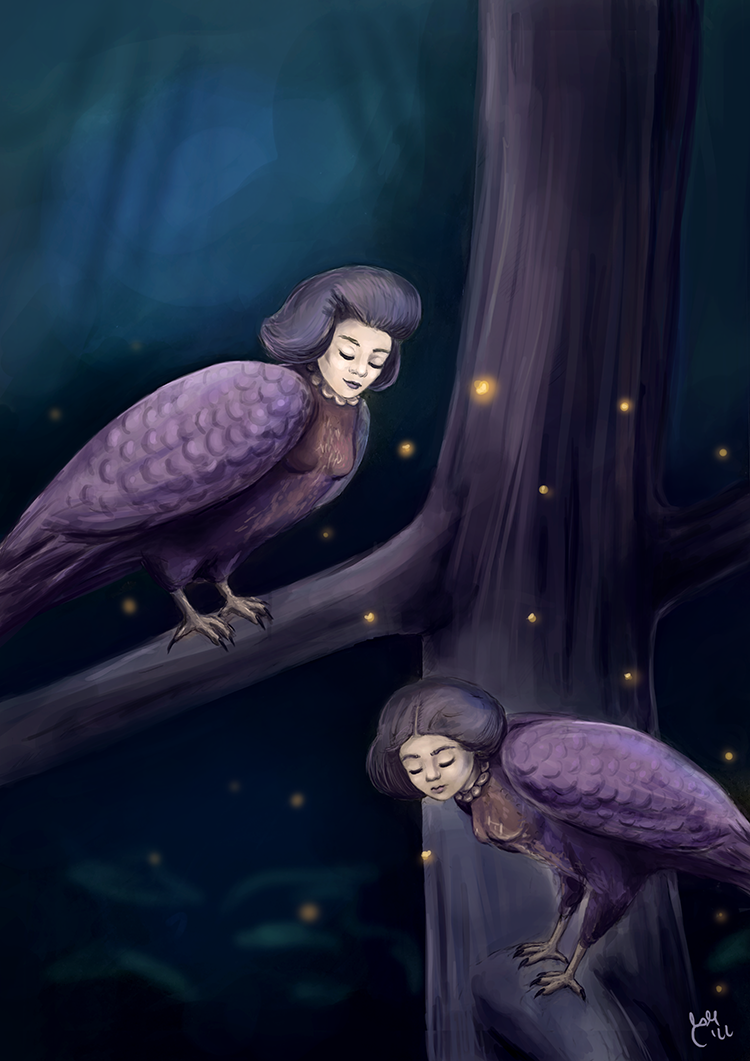

Alkonost is a bird of paradise from Russian medieval tradition – half woman, half bird – whose song carries both joy and a quiet danger. She dwells at the edge of the world, between sea and sky, in a place called Iriy: the paradise land to which birds fly in winter and souls travel after death. Her voice weaves dreams so radiant that those who hear it lose all memory of grief – and all memory of the path home.
Song of Paradise
Alkonost appears not in the oldest layers of Slavic mythology, but in medieval Russian religious art and the lubok – the illustrated folk prints that circulated widely from the seventeenth century onward. In these images she is depicted with the body of a large bird, the head and sometimes the arms of a woman, often holding a scroll or a branch, hovering above the waters of paradise.
Her song is not an ordinary melody. When she sings, storms grow still, sorrow fades, and the heart fills with a bliss that is indistinguishable from forgetting. Those who linger too long do not return – not because they are taken, but because they no longer wish to leave.
To hear Alkonost is to forget all sorrow and all paths home.
Heaven and Shadow
In Slavic tradition, Alkonost is rarely depicted alone. She is most often paired with Sirin, a bird of sorrow – the dark mirror to Alkonost’s light. Together they appear on countless lubok prints, facing one another as twin forces: one the voice of paradise, the other the voice of grief.
A third bird completes the group in some traditions: Gamayun, the bird of prophecy, whose song does not comfort or destroy but foretells. Where Alkonost sings of what is beautiful and Sirin of what is lost, Gamayun sings of what is coming – whether or not the listener is ready to hear it.
Alkonost sings of paradise, Sirin of sorrow, and both are true.
The Seven Days
The legend of the seven days traces back to the Greek myth of Alcyone, daughter of Aeolus, who was transformed into a halcyon bird. In the Greek story, the gods still the seas for seven days each winter so that she may lay her eggs in peace. This myth entered Slavic tradition through Byzantine literary transmission and attached itself to Alkonost, giving her a second nature: not only a singer of paradise, but a bird of weather.
In the Slavic retelling, when Alkonost lays her eggs by the seashore, the waters remain calm for seven days – hushed by her presence. When the eggs hatch, the stillness breaks. The stir of new life releases the storms held in waiting, and the sea erupts in tumult.
Seven days the sea lies silent, until her young awaken the storm.
Beauty and Its Edge
Alkonost is a living reminder of the double edge of beauty. Her presence soothes and lifts the spirit, but the same song that brings bliss carries the risk of dissolution – of surrendering so completely to wonder that nothing else remains.
She does not deceive. She does not hunt. She simply sings, and the danger is entirely in the listener’s willingness to stay. She shares this quality with figures like Rusalka – beauty that is not malicious, simply powerful enough to overwhelm.
The paradise she inhabits is the same boundary land that Veles guards at the edge of the living world – where birds go in winter and the dead in their season.
Beauty can lift the spirit, or consume it – as whispered in every note of Alkonost’s song.


