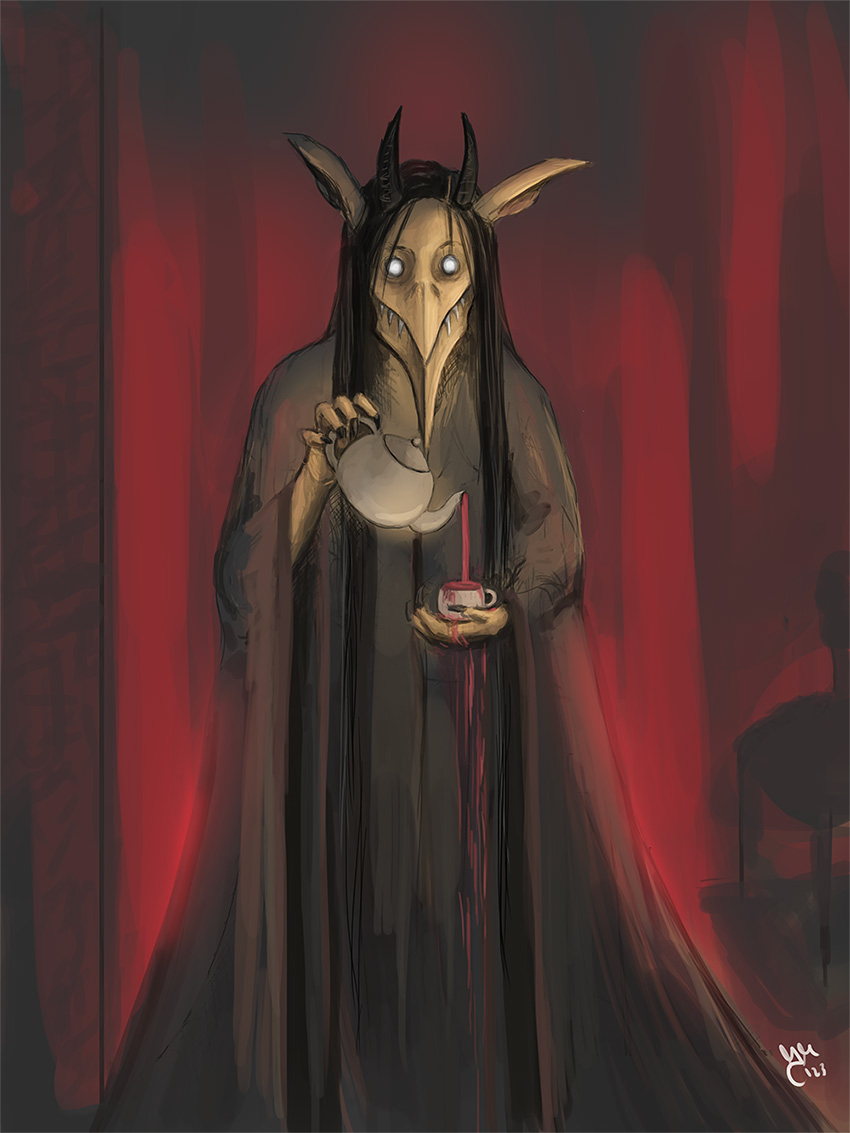


Kikimora is the shadow that slips through the cracks of the hearth, a household spirit both feared and appeased in Slavic lore. She is no simple ghost but a presence that dwells in corners and dreams, bringing fortune to some and torment to others. Where she lingers, silence is uneasy and sleep unsettled.
She belongs to no one and knows every house. Born, some say, of grief unspoken – a child taken before her name was given, a girl buried beneath the floorboards, a bride who never reached her wedding day – she is a household spirit shaped from sorrow and stubbornness alike. Once she finds a home, she does not leave.
Appearance
Kikimora’s form is ever-shifting. Some tales describe her as a small, haggard woman with tangled hair, long fingers, and a birdlike face. Others paint her as a crooked shadow or a frail figure in rags, slipping quietly by the stove. She can seem pitiful, almost harmless – until the moment her eyes gleam in the dark.
When the house creaks without reason, they say Kikimora is moving.
In some villages she was said to wear the clothes of the last woman who had lived in the house, stitched into ragged imitation. In others, her face could never be remembered the morning after – only the weight of her gaze, pressing from the dark corner behind the stove.
Nature and Behavior
Kikimora does not wait to be invited. You may lock the doors and seal the windows, yet she finds her way in – through keyholes, beneath doorframes, or carried on the night air itself.
Once inside, she weaves her presence into the household. At times she acts as a strange helper: sweeping floors, spinning yarn, even pouring tea for the family she favors.
But her aid is never without unease – yarn tangles, tools break, the cup tips and spills before reaching your lips. To live with Kikimora is to never know if she comes as servant or saboteur.
She will serve you, but never as you expect.
Domovoi and Duality
In Slavic belief, Kikimora often appears opposite the Domovoi, the protective house spirit. Where the Domovoi blesses, she unsettles; where he guards, she disrupts. Yet together they form a balance – blessing and curse, order and chaos – a reminder that every home holds both comfort and shadow.
Where Kikimora keeps the hearth restless, Ovinnik keeps the threshing barn – one within the house, one at its edge, each watching over the work that feeds the family, each demanding respect in their own way. Between them, the old homesteads were never left unwatched.
Folklore and Fear
Charms against Kikimora were common: spinning wheels covered at night, iron objects left by the hearth, and protective prayers whispered before bed. Her presence explained restless nights, broken dishes, and eerie noises in the dark. To some she was a trickster maid; to others, an omen of illness or misfortune.
If you hear scratching behind the stove, do not answer – it may be Kikimora counting your days.
Mothers tied red threads around cradles, for Kikimora was said to linger near new babies, rocking them too long and too far. Grandmothers left a small bowl of milk in the corner overnight – not as offering, but as distraction. And no one, in those old houses, ever sat in the chair closest to the stove after dark. It was understood that seat had another owner.
Her story echoes another, older shadow at the edge of the Slavic home – the crone in the deep woods, Baba Yaga, whose hut stands on chicken legs and whose temper is its own weather. Both are the figure the house fears and the figure the house needs; both remind the living that thresholds are never empty.
The Enigma of Kikimora
Neither wholly evil nor wholly benign, Kikimora embodies the uncertainty of the home – the place that shelters and suffocates, comforts and unsettles. She is the whisper of doubt in the quiet night, the reminder that safety is never absolute.
Those who live with Kikimora learn this: peace must be kept, for unrest always finds a way in.


