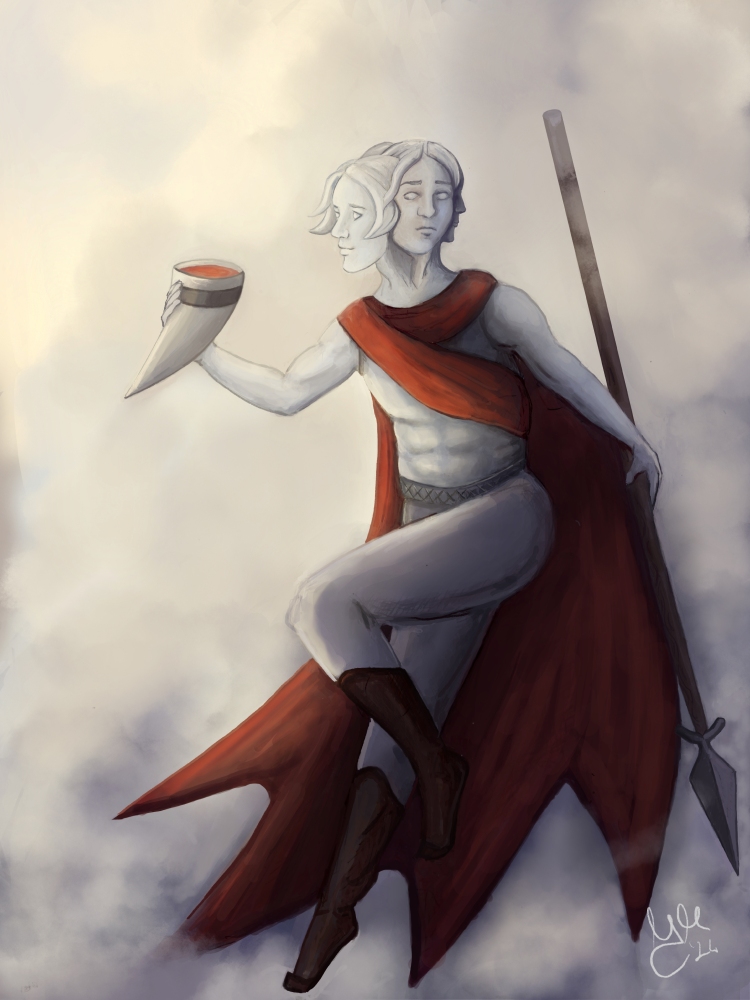


Svetovid is the four-faced seer, his gaze turning to all points of the world. In Slavic mythology he is the god of prophecy, war, and abundance, he rides forth on his sacred white horse, carrying visions of what was, what is, and what is yet to come. In his sight lies both hope and dread.
On the white cliffs of Rügen, where the Baltic crashes against the last stone of the shore, once stood his great temple – a stronghold of timber and white cloth, lit by the turning of the sun. From there his four faces looked outward to the four winds, and no secret in the old lands escaped him for long.
Appearance & Nature
Depicted with four faces, each watching a different horizon, Svetovid sees through lies and into fate itself. Upon his horse, he is both guardian and judge, moving between battlefields and harvest fields alike. His horn of mead, filled to the brim, foretells the fortune of the coming year.
His gaze pierces masks and finds the truth beneath.
One face watches the dawn and the coming day, one the dusk and what passes into memory, one the still noon of the fields, one the depth of the winter night. No direction is hidden from him – north, south, east, west – and the winds that blow across the world carry word to his four ears at once.
And beneath all four gazes rides the white horse, his silence carrying what the god does not need to speak. Where the hoof falls, a door opens; where the god looks, a door closes. Nothing under the sky stands outside that reckoning.
Lord of Fate & Battle
Svetovid was honored as arbiter of victory and protector of prosperity. Warriors sought his favor before war, farmers prayed for his blessing on their fields, and rulers feared his judgment as much as they revered it. His fourfold sight made him patron of both sword and harvest.
He holds both sword and harvest; fate walks at his side.
When kings came to him, it was not grace they sought but warning. When soldiers came, it was not hope they sought but knowing. Svetovid gave both without flattery – his horn did not lie, and his horse did not pretend.
The same longing that drew folk to his cliffs drew them to other high seats of the old lands. Before the three watchful heads of Triglav, keeper of the three worlds, they asked what lay in store; beneath the storm-hammer of Perun, the thunder-lord, they asked whose roof would stand and whose would fall. Svetovid answered in his own way – with hoof and horn.
Rituals & Offerings
At his shrines, fourfold offerings – bread, grain, wine, and livestock – were given to the four directions, each laid at the foot of the faces that watched them. Yet the heart of his worship lay in the oracle of his white horse.
This sacred steed was kept within the temple and treated as the god’s own companion. No hand but the priest’s could touch him, and no rider but Svetovid himself was said to mount him in the long nights, returning the horse at dawn weary and streaked with the dust of unseen roads.
During rituals, priests led the horse between rows of upright spears. Every movement was read as a sign: if the horse stepped first with its right hoof, it foretold victory; if with the left, it warned of defeat. The outcome of wars, raids, and even the fate of entire kingdoms was entrusted to these omens.
The people believed that through the horse’s stride, Svetovid himself revealed his will.
Each year, at the great harvest feast, the priest looked into the horn the god had held since midsummer. If the mead within had dwindled, a lean year was spoken of. If it stood full, the people rejoiced – for Svetovid had kept his cup steady, and the land would give freely.
The horn keeps the count, and the god keeps the year.
The Enigma of Svetovid
More than a war-god or giver of plenty, Svetovid is the sight that does not flinch. To call on him is to invite clarity – answers that can bless or break. Those who ask must be ready to bear what is shown.
Vision demands courage – for the truth is not always kind.


