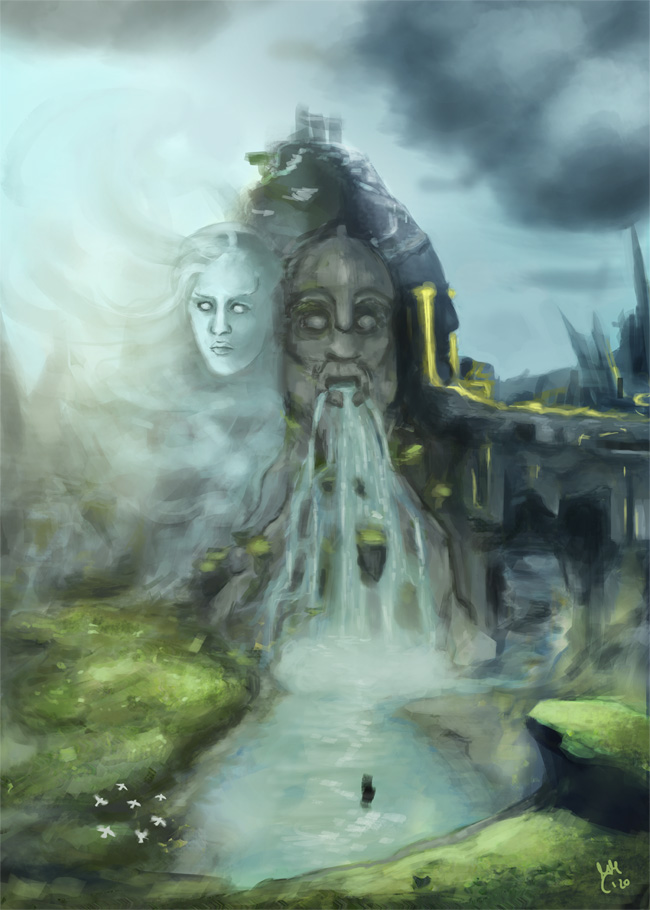


Triglav is the three-headed god of the Slavic world, his three faces turned toward sky, earth, and the underworld. He does not rule one realm. He holds all three in balance, standing at the axis where they meet – and where the world either holds together or comes apart.
He is one of the few Slavic deities attested in written historical sources. Twelfth-century chronicles recording the Christianisation of Pomerania describe his temples, his idol, his rituals, and the black horse kept in his service. What survives is fragmentary – but what survives is specific.
Appearance & Nature
Triglav’s idol, as described by the chroniclers Herbord and Ebbo, bore three heads rising from a single body. A golden veil was draped over his eyes and mouth – not as concealment, but as a marker of threshold: what lay beyond it was not hidden. It was simply of a different order.
His three faces watched the three realms: one toward the sky, one toward the fields, one toward the shadow beneath. The sky realm does not present itself plainly. It blurs into mist at the edge of stone, hangs between cloud and mountain, thins where the light comes through and reforms where it does not. The golden veil in the temple was its image made physical – the boundary where the eye follows as far as it can, and no further.
Three Realms
The three realms Triglav holds in balance are not abstractions. They are inhabited.
The sky carries storms, breath, and the weight of what cannot be named. The underworld is the domain of Veles, god of the dead, cattle, and hidden wealth. Between them lies the earth – where humans live out the fates assigned to them.
Triglav does not govern these realms separately. He is the point where they converge. Without that convergence, sky and earth and the dark below would pull apart. He is less a god of power than a god of structural necessity – the balance that makes the world possible at all.
When the three fall out of step, the world trembles.
Rituals & Offerings
Triglav’s cult is better documented than most Slavic deities. His main temple at Szczecin stood on the highest of the city’s three hills – described in detail by Herbord in the twelfth century as a richly decorated structure where his veiled idol stood and his priests maintained his service.
Offerings were made in threes: to sky, earth, and underworld simultaneously. White, green, and black. To honor one realm while neglecting the others was not devotion – it was imbalance, and Triglav was not a god who accepted partial acknowledgment.
The black horse oracle was central to his rites. A consecrated black horse was led between rows of spears planted in the ground. Priests read the omens from how it moved – which spears it stepped between, which it avoided, whether it walked freely or resisted. The horse was his instrument of answer, speaking for all three realms at once.
He hears those who honor all worlds, not only one.
The Veiled God
The golden veil covering Triglav’s idol was not silence. It was a threshold made visible – the place where one realm ends and another begins, where the human eye gives way to something else entirely.
The heavenly realm does not stand apart from the world. It is present in every shift of weather, every morning where the mountain disappears into cloud, every moment when the boundary between earth and sky seems close enough to touch. The veil does not separate. It marks the edge of what can be followed.
To worship Triglav was to stand at that edge deliberately – to acknowledge that the world does not end where sight does.
Those who keep the balance walk with the strength of three worlds.


